The Mortuary Science program at Mesa Community College
has as its central aim recognition of the importance of funeral service personnel as:
Members of a human services profession;
Members of the community in which they serve;
Participants in the relationship between bereaved families and those engaged in the funeral service profession;
Professionals knowledgeable of and compliant with federal, state, provincial/territorial, and local regulatory guidelines in the geographic area where they practice as well as
Professionals sensitive to the responsibility for public health, safety, and welfare in caring for human remains.
The program has the following objectives:
To enlarge the background and knowledge of students about the funeral service profession;
To educate students in every phase of funeral service and to help enable them to develop proficiency and skills necessary for the profession;
To educate students concerning the responsibilities of the funeral service profession in the community at large;
To emphasize high standards of ethical conduct;
To provide a curriculum at the post-secondary level of instruction; and
To encourage student and faculty research in the field of funeral service.
Associate in Applied Science (AAS) in Mortuary Science
The program is a member of the National Association of Colleges of Mortuary Science (NACMS). As such, it is permitted to grant membership into Mu Sigma Alpha, the National Honor Society of Mortuary Science.
The Associate in Applied Science degree (AAS) in Mortuary Science includes studies in public health, business management, natural sciences, legal, ethical and regulatory concerns, and clinical requirements associated with the mortuary field. The curriculum combines coursework in mortuary science with a general education component. The Associates in Applied Science degree from Mesa Community College is accredited by the American Board of Funeral Service Education (ABFSE). Completion of the program prepares the student to sit for the National Board examination and begin state internship requirements.
As the only program of its kind in South Carolina, and one of only a handful of public college programs in mortuary science in the United States, Piedmont Technical College’s ABFSE-accredited Funeral Service Education program is well equipped to prepare students for a rewarding career in the Funeral Service and Mortuary Industry.
The program offers both an Associate of Applied Science degree and a certificate.
The associate degree offers students the educational foundation needed to seek licensure in South Carolina or in another state, both as a funeral director and an embalmer.
The certificate, which is available only online, was developed for students interested in becoming licensed funeral directors in the Carolinas. The courses in this program will prepare students to take the South and North Carolina Funeral Directors’ Exams.
The Funeral: A Service of Witness to the Resurrection
Placing of the Pall
Sentences of Scripture
Psalm, Hymn or Spiritual
Prayer
Confession and Pardon
Readings from Scripture
Sermon
Affirmation of Faith
Hymn
Prayers of Thanksgiving, Supplication and Intercession
(or, The Sacrament of the Lord’s Supper)
Lord’s Prayer
Commendation
Blessing
Procession
Family members will pray around the body as soon as possible after death. People will try to avoid touching the corpse as it is considered polluting. The corpse is usually bathed and dressed in white, traditional Indian clothes. If a wife dies before her husband she is dressed in red bridal clothes. If a woman is a widow she will be dressed in white or pale colours.
The funeral procession may pass places of significance to the deceased, such as a building or street. Prayers are said here and at the entrance to the crematorium.
The body is decorated with sandalwood, flowers and garlands. Scriptures are read from the Vedas or Bhagavad Gita. The chief mourner, usually the eldest son or male, will light some kindling and circle the body, praying for the well being of the departing soul.
After the cremation, the family may have a meal and offer prayers in their home. Mourners wash and change completely before entering the house after the funeral. A priest will visit and purify the house with spices and incense. This is the beginning of the 13-day mourning period when friends will visit and offer their condolences.
‘Shradh’ is practiced one year after the death of the person. This can either be an annual event or a large one-off event. This is the Hindu practice of giving food to the poor in memory of the deceased. A priest will say prayers for the deceased and during this time, usually lasting one month, the family will not buy any new clothes or attend any parties. Sons are responsible for carrying out Shradh.

1.As Death Approaches: Traditionally, a Hindu dies at home. Nowadays the dying are increasingly kept in hospitals, even when recovery is clearly not possible. Knowing the merits of dying at home among loved ones, Hindus bring the ill home. When death is imminent, kindred are notified. The person is placed in his room or in the entryway of the house, with the head facing east. A lamp is lit near his head and he is urged to concentrate on his mantra. Kindred keep vigil until the great departure, singing hymns, praying and reading scripture. If he cannot come home, this happens at the hospital, regardless of institutional objections.
2.The Moment of Death: If the dying person is unconscious at departure, a family member chants the mantra softly in the right ear. If none is known, “Aum Namo Narayana” or “Aum Nama Sivaya” is intoned. (This is also done for sudden-death victims, such as on a battlefield or in a car accident.) Holy ash or sandal paste is applied to the forehead, Vedic verses are chanted, and a few drops of milk, Ganga or other holy water are trickled into the mouth. After death, the body is laid in the home’s entryway, with the head facing south, on a cot or the ground—reflecting a return to the lap of Mother Earth. The lamp is kept lit near the head and incense burned. A cloth is tied under the chin and over the top of the head. The thumbs are tied together, as are the big toes. In a hospital, the family has the death certificate signed immediately and transports the body home. Under no circumstances should the body be embalmed or organs removed for use by others. Religious pictures are turned to the wall, and in some traditions mirrors are covered. Relatives are beckoned to bid farewell and sing sacred songs at the side of the body.
3.The Homa Fire Ritual: If available, a special funeral priest is called. In a shelter built by the family, a fire ritual (homa) is performed to bless nine brass kumbhas (water pots) and one clay pot. Lacking the shelter, an appropriate fire is made in the home. The “chief mourner” leads the rites. He is the eldest son in the case of the father’s death and the youngest son in the case of the mother’s. In some traditions, the eldest son serves for both, or the wife, son-in-law or nearest male relative.
4.Preparing the Body: The chief mourner now performs arati, passing an oil lamp over the remains, then offering flowers. The male (or female, depending on the gender of the deceased) relatives carry the body to the back porch, remove the clothes and drape it with a white cloth. (If there is no porch, the body can be sponge bathed and prepared where it is.) Each applies sesame oil to the head, and the body is bathed with water from the nine kumbhas, dressed, placed in a coffin (or on a palanquin) and carried to the homa shelter. The young children, holding small lighted sticks, encircle the body, singing hymns. The women then walk around the body and offer puffed rice into the mouth to nourish the deceased for the journey ahead. A widow will place her tali (wedding pendant) around her husband’s neck, signifying her enduring tie to him. The coffin is then closed. If unable to bring the body home, the family arranges to clean and dress it at the mortuary rather than leave these duties to strangers. The ritual homa fire can be made at home or kindled at the crematorium.
5.Cremation: Only men go to the cremation site, led by the chief mourner. Two pots are carried: the clay kumbha and another containing burning embers from the homa. The body is carried three times counterclockwise around the pyre, then placed upon it. All circumambulating, and some arati, in the rites is counterclockwise. If a coffin is used, the cover is now removed. The men offer puffed rice as the women did earlier, cover the body with wood and offer incense and ghee. With the clay pot on his left shoulder, the chief mourner circles the pyre while holding a fire brand behind his back. At each turn around the pyre, a relative knocks a hole in the pot with a knife, letting water out, signifying life’s leaving its vessel. At the end of three turns, the chief mourner drops the pot. Then, without turning to face the body, he lights the pyre and leaves the cremation grounds. The others follow. At a gas-fueled crematorium, sacred wood and ghee are placed inside the coffin with the body. Where permitted, the body is carried around the chamber, and a small fire is lit in the coffin before it is consigned to the flames. The cremation switch then is engaged by the chief mourner.
6.Return Home; Ritual Impurity: Returning home, all bathe and share in cleaning the house. A lamp and water pot are set where the body lay in state. The water is changed daily, and pictures remain turned to the wall. The shrine room is closed, with white cloth draping all icons. During these days of ritual impurity, family and close relatives do not visit others’ homes, though neighbors and relatives bring daily meals to relieve the burdens during mourning. Neither do they attend festivals and temples, visit swamis, nor take part in marriage arrangements. Some observe this period up to one year. For the death of friends, teachers or students, observances are optional. While mourning is never suppressed or denied, scriptures admonish against excessive lamentation and encourage joyous release. The departed soul is acutely conscious of emotional forces directed at him. Prolonged grieving can hold him in earthly consciousness, inhibiting full transition to the heaven worlds. In Hindu Bali, it is shameful to cry for the dead.
7.Bone-Gathering Ceremony: About 12 hours after cremation, family men return to collect the remains. Water is sprinkled on the ash; the remains are collected on a large tray. At crematoriums the family can arrange to personally gather the remains: ashes and small pieces of white bone called “flowers.” In crematoriums these are ground to dust, and arrangements must be made to preserve them. Ashes are carried or sent to India for deposition in the Ganges or placed them in an auspicious river or the ocean, along with garlands and flowers.
8.First Memorial: On the 3rd, 5th, 7th or 9th day, relatives gather for a meal of the deceased’s favorite foods. A portion is offered before his photo and later ceremonially left at an abandoned place, along with some lit camphor. Customs for this period are varied. Some offer pinda (rice balls) daily for nine days. Others combine all these offerings with the following sapindikarana rituals for a few days or one day of ceremonies.
9. 31st-Day Memorial: On the 31st day, a memorial service is held. In some traditions it is a repetition of the funeral rites. At home, all thoroughly clean the house. A priest purifies the home, and performs the sapindikarana, making one large pinda (representing the deceased) and three small, representing the father, grandfather and great-grandfather. The large ball is cut in three pieces and joined with the small pindas to ritually unite the soul with the ancestors in the next world. The pindas are fed to the crows, to a cow or thrown in a river for the fish. Some perform this rite on the 11th day after cremation. Others perform it twice: on the 31st day or (11th, 15th, etc.) and after one year. Once the first sapindikarana is completed, the ritual impurity ends. Monthly repetition is also common for one year.
10.One-Year Memorial: At the yearly anniversary of the death (according to the moon calendar), a priest conducts the shraddha rites in the home, offering pinda to the ancestors. This ceremony is done yearly as long as the sons of the deceased are alive (or for a specified period). It is now common in India to observe shraddha for ancestors just prior to the yearly Navaratri festival. This time is also appropriate for cases where the day of death is unknown.
Hindu funeral rites can be simple or exceedingly complex. These ten steps, devotedly completed according to the customs, means, and ability of the family, will properly conclude one earthly sojourn of any Hindu soul.
The Order of Service Layout
Order of Service Cover:
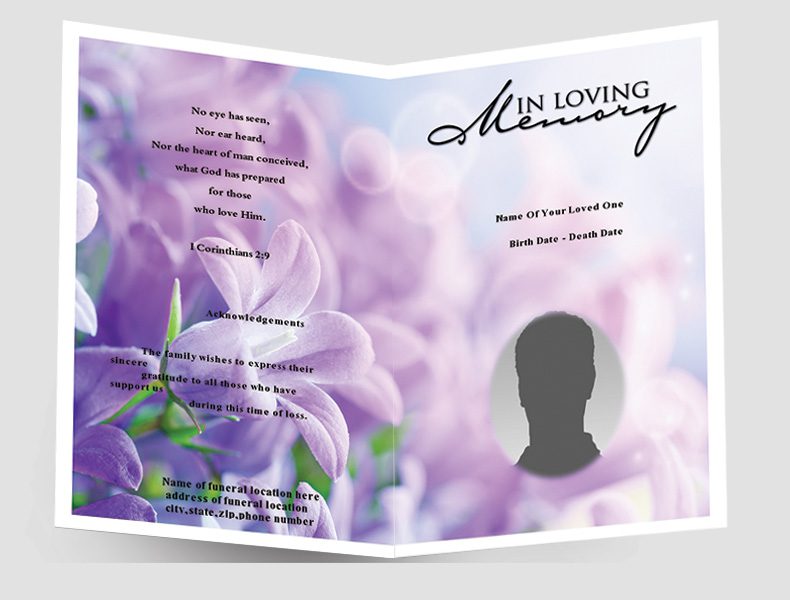
The cover of the order of service contains the full legal name, date of birth, date of death, location and time of service. The cover will sometimes have a photo of the deceased, and sometimes the cover contains a caption such as “In Loving Memory” or “Celebration of Life”
Order of Service Outline:
Music Plays (Procession)
Introduction — Opening Remarks to start the occasion
Music, Song or Hymn is sung or a verse or poem is recited (The verse, funeral poem, or song is usually listed in the booklet)
Funeral Readings
Memories of the Deceased, Eulogy, Tribute
Music Poem or Reading
Prayers
Hymn or Music (lyrics listed in Order of Service)
Committal and Blessing
Closing Music
Back Cover of Order of Service
The back Cover usually contains expressions of thanks from the family, and the place where the repass or reception. Also, if you have any special donation requests, you can include them.
View our Order of Service Templates
Order of Service Template